| Structural layer | Material |
| Electrolyte | 8YSZ |
| Barrier layer | GDC |
| Anode | NiO-8YSZ |
| Cathode | LSC |
| Metal support | SUS 430L |
| Component | Unit | Parameter |
| Electrolyte thickness | μm | 8–13 |
| GDC thickness | μm | 2–3 |
| Anode thickness | μm | 350 |
| Cathode thickness | μm | 20–25 |
| Total cell thickness | μm | 0.65-0.75 |
| Standard size | mm | φ15, φ20, φ100, □50, □100 (custom shapes available) |
| Operating temperature | ℃ | 650 ~ 750 |
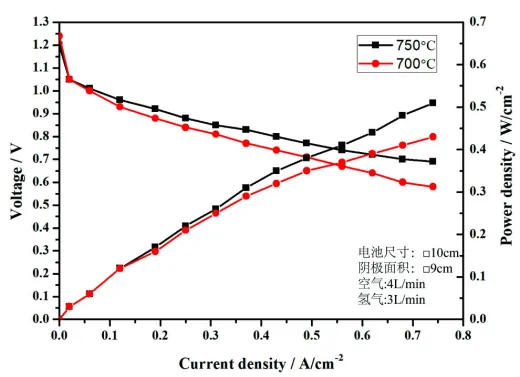
| Temperature | 700 ℃ | 750 ℃ |
| Current density at 0.7 V (A/cm²) | 0.55 | 0.74 |
| OCV(V) | 1.19 | 1.18 |
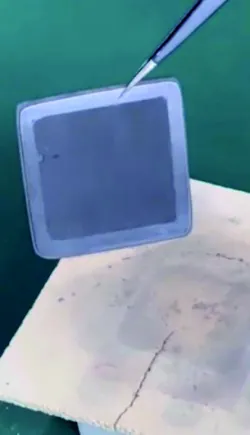
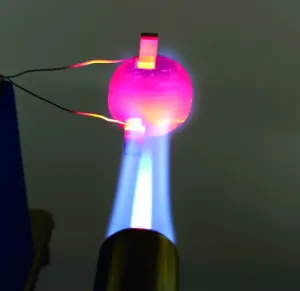
Three sets of photographs demonstrate the thermal shock resistance and direct power generation capability of MS-SOFC: after combustion in a hydrogen flame and 1 minute of heating the cell remains intact; butane gas combustion generates power directly (the cell glows red-hot in the flame).
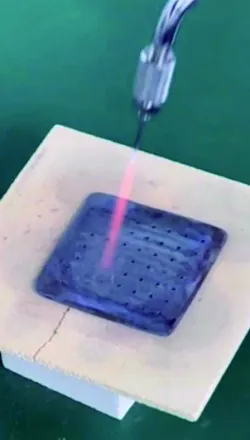

Heated for 1 minute
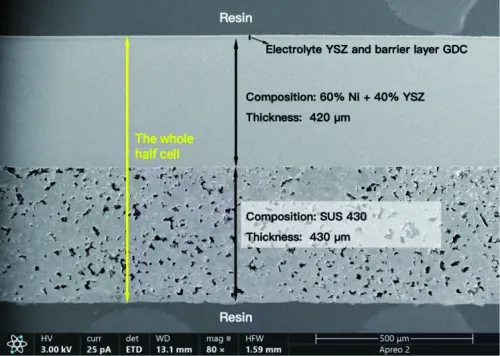
Half-cell SEM cross-section: GDC barrier layer - 8YSZ electrolyte - Ni-8YSZ functional layer - SUS430 metal support